Kyoto has more than sixteen hundred Buddhist temples and four hundred Shinto shrines, yet ninety percent of visitors gather inside the same six gates between ten in the morning and four in the afternoon.
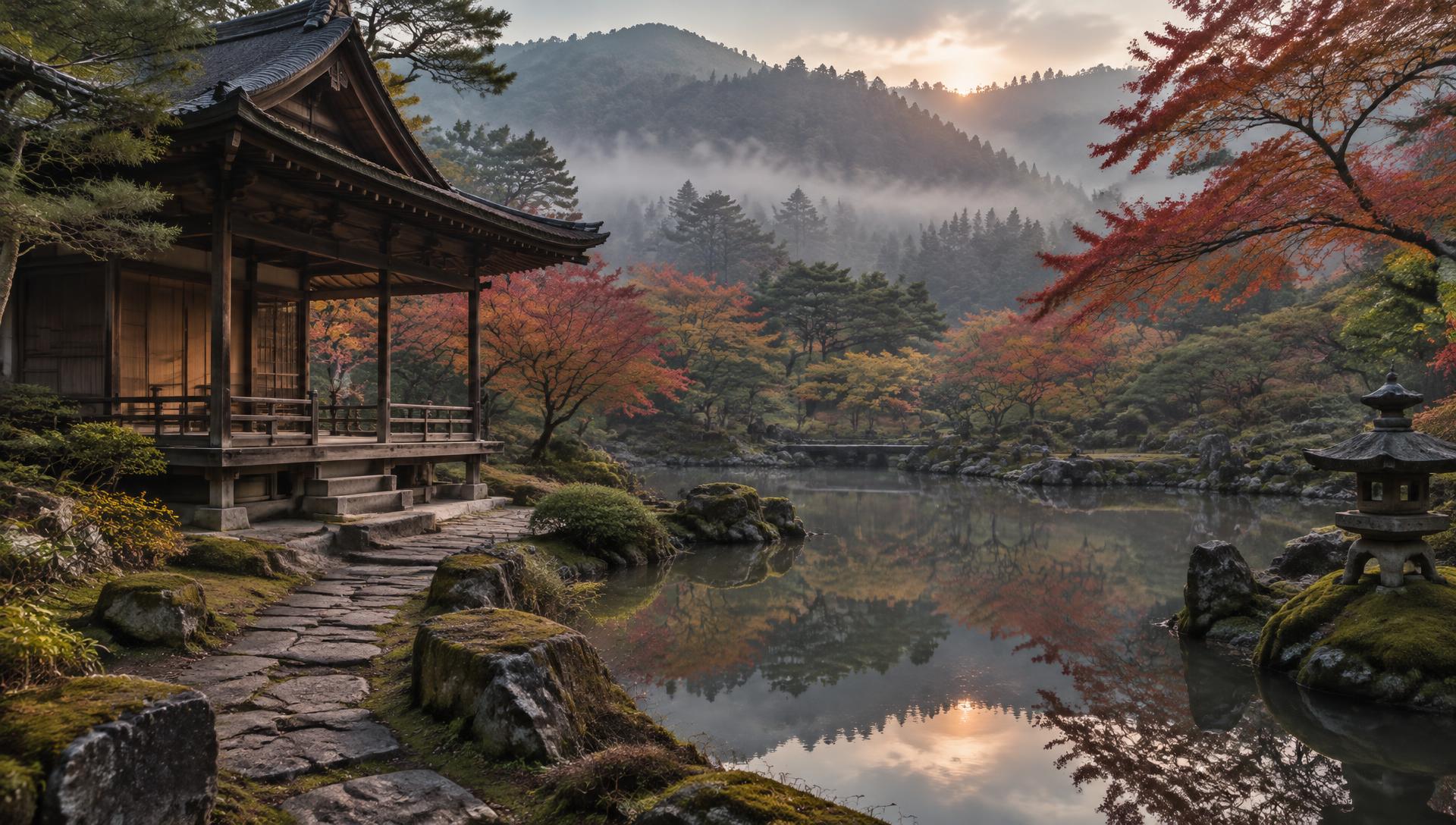
For travellers planning a holiday to Japan with an eye for stillness, the former imperial capital remains one of the most rewarding cities in Asia—provided you understand how its geography works. Laid out in 794 AD on a grid framed by three mountain ranges—Higashiyama to the east, Kitayama to the north, and Nishiyama to the west—Kyoto’s finest moments happen along the forested perimeter where the grid dissolves into cedar valleys and mountain streams. Step twenty minutes north or south of the tour-bus corridors, and you find yourself entirely alone on a sun-warmed cedar veranda listening to bamboo water clappers echo across a fourteenth-century moss garden.
Experiencing that version of Kyoto requires trading the checklist for a neighborhood rhythm: walking one quiet district each morning, resting during the midday rush, and letting the craft traditions of tea, ceramics, and carpentry guide your afternoons.
Reading the geography of the three-mountain basin
Because Kyoto’s historic monuments are spread across a wide valley floor and its surrounding foothills, crossing from the west side of the city to the east in a single morning means spending hours on city buses. The secret to unhurried Japan holidays here is grouping your days strictly by watershed and slope.
Two clear rivers flow down from the northern mountains—the Takano and the Kamo—joining in a Y-shape at the delta of Demachiyanagi before running south through the heart of the city. Using the Kamo River footpath as your compass, you can walk or cycle for miles beneath weeping willows without touching a main traffic artery, branching eastward into the temple hills or westward into the historic weaving quarters.
Northern Higashiyama: Honen-in, Shisen-do, and the Ichijoji foothills
While the southern end of the Philosopher’s Path near Nanzen-ji can grow busy by late morning, few visitors walk the five minutes uphill into the bamboo grove that conceals Honen-in. Entering through its thatched moss gate, you pass between two raised rectangles of raked white sand—known as byakusadan—sculpted with seasonal patterns of water and fallen camellia blossoms that symbolize the cleansing of the mind before entering sacred ground.
Twenty minutes further north, in the residential foothills of Ichijoji, three extraordinary hillside sanctuaries sit within walking distance of one another. Shisen-do, built in 1641 as the mountain hermitage of scholar and landscape poet Ishikawa Jozan, opens onto an intimate tiered garden of clipped azalea spheres and raked sand backed by wild forest. Nearby Enko-ji and Manshu-in frame views across the Kyoto basin through dark timber sliding screens that act like living horizontal scrolls.

The walled Zen compounds of Daitoku-ji and Myoshin-ji
In northern and northwestern Kyoto stand two vast Rinzai Zen monastery complexes that operate like walled towns within the city: Daitoku-ji and Myoshin-ji. Unlike single-monument temples, each complex contains more than twenty autonomous sub-temples (tatchu) connected by wide stone walkways shaded by ancient pines.
At Daitoku-ji, intricately tied closely to the history of the Japanese tea ceremony and tea master Sen no Rikyu, three or four sub-temples open their wooden gates at any given time. Inside Daisen-in, one of the great masterpieces of Muromachi-period karesansui (dry landscape) design uses upright slate stones and raked gravel in a space no wider than a hallway to depict a mountain river rushing through gorges before emptying into a calm ocean of white sand. Across the courtyard at Koto-in or Ryogen-in, you can sit on aged tatami in complete silence for an hour without hearing a sound beyond wind in the maples.
“In a Kyoto garden, the walls are not built to shut the world out, but to frame a small piece of nature finely enough that you finally pay attention to it.”
Neighborhood ledger: Crowded icons and their quiet counterparts
Use this geographic ledger to replace Kyoto’s most congested midday stops with serene sanctuaries sharing the same architectural lineage and natural setting:
| Kyoto District | Busy Midday Icon | Quieter Slow-Travel Counterpart | Best Time of Day | Defining Atmosphere |
|---|---|---|---|---|
| Northern Higashiyama (Sakyo-ku) | Ginkaku-ji (Silver Pavilion) Main Path | Honen-in, Shisen-do, Enko-ji & Manshu-in Monzeki | 8:30 AM – 11:00 AM | Thatched moss gates, poet hermitages & bamboo forest water chimes |
| Northern Zen Quarter (Kita-ku) | Kinkaku-ji (Golden Pavilion) | Daitoku-ji Sub-Temples (Daisen-in, Ryogen-in) & Myoshin-ji Taizo-in | 9:00 AM – 12:00 PM | Intimate Muromachi dry-gravel Zen gardens & historic tea rooms |
| Western Foothills (Saga-Arashiyama) | Central Arashiyama Bamboo Alley at Noon | Otagi Nenbutsu-ji, Adashino Bamboo Grove & Gio-ji Moss Sanctuary | 7:30 AM – 10:30 AM | 1,200 mossy stone statues & downhill walk through preserved thatched cottages |
| Southern Mountains & Inari | Fushimi Inari Lower Torii Plaza | Tofuku-ji Komyo-in (Rainbow Moss Temple) & Upper Mt. Inari Forest Trails | 6:00 AM – 8:00 AM (or 3:30 PM) | Ridge-line shrine paths through cedar forest & open-veranda Zen gardens |
| Northern Mountain Valleys | Kiyomizu-dera Midday Slope | Ohara Rural Valley (Sanzen-in & Jakko-in) & Kurama-Kibune Forest Trail | 9:00 AM – 2:30 PM | Mountain village streams, towering cryptomeria cedars & velvet moss carpets |

Walking down from Otagi Nenbutsu-ji and into the Ohara valley
To see western Kyoto’s Arashiyama district at its best, take a morning taxi all the way to the top of the valley at Otagi Nenbutsu-ji as it opens at eight. Tucked against the forested slope, the temple grounds hold twelve hundred whimsical, moss-covered stone statues of rakan (Buddhist disciples), each carved with a distinct expression. From there, walk gently downhill along the preserved Saga-Toriimoto street—lined with traditional thatched-roof farmhouses and persimmon trees—pausing at the quiet bamboo grove of Adashino Nenbutsu-ji and the jewel-like moss clearing of Gio-ji before the day crowds ever reach the river bridge below.
On another morning, board a local bus forty minutes northeast into the mountain basin of Ohara. Surrounded by shiso fields and vegetable plots, the temple of Sanzen-in sits beneath giant cryptomeria cedars where clear mountain meltwater trickles through carpets of haircap moss. Even in the height of autumn, Ohara retains the unhurried air of a medieval mountain village.
Extending a Japan tour: Nara, Koyasan, Kanazawa, and the seasons
Kyoto also serves as the natural anchor for broader Japan travel trips across central Honshu. Forty-five minutes south by train lies Nara, Japan’s eighth-century capital; walk up through the stone lanterns of Kasuga Taisha to the wooden balcony of Todai-ji’s Nigatsu-do hall at dawn for a sweeping view over the ancient plain. Further south in the forested peaks of Wakayama, Mount Koya (Koyasan) invites travellers to spend a night in a shukubo temple lodging, waking at six for morning fire rituals and walking the two-kilometre cedar avenue of Okunoin cemetery.
While spring cherry blossoms and November maples are justly celebrated, never overlook the quiet months in between. In May and June, the aomomiji season turns every maple canopy a luminous translucent green and early summer rains awaken the temple moss; in January and February, cold mountain air sharpens the light, plum blossoms open in shrine courtyards, and Kyoto’s oldest gardens return to complete stillness.
Practical Notes
Questions travellers often ask
How many days should you allocate to Kyoto on a holiday to Japan?
Set aside at least five to six full nights in Kyoto on a two-week holiday to Japan. While hurried itineraries compress the city into two days of crowded landmarks, five nights allow you to explore one geographic corner of the mountain basin each morning—such as northern Higashiyama, Daitoku-ji, upper Arashiyama, and the rural valley of Ohara—while leaving afternoons free for teahouses, craft studios, and riverside walks.
How can you experience Kyoto without heavy tourist crowds?
Three habits transform Kyoto completely: first, visit open-gate shrines such as Fushimi Inari (climbing the upper Mount Inari forest trails) or the lanes of Yasaka between 6:00 AM and 7:30 AM; second, spend midday hours in lesser-known neighbourhood temples like Shisen-do, Enko-ji, Honen-in, or the sub-temples of Daitoku-ji and Myoshin-ji; and third, walk the backstreets along the Shirakawa canal and Kamo River rather than the main commercial avenues.
When is the best season to plan Japan holidays for Kyoto?
Late October through early December (autumn maple season, koyo) and late March through mid-April (cherry blossom season, sakura) are visually extraordinary, with crisp 12°C to 20°C days. However, for slow travellers seeking deep tranquillity, May and early June offer the luminous 'green maple' season (aomomiji) when temple moss is at its richest emerald hue, while January and February bring crisp, crowd-free winter mornings.
Which temples in Kyoto require advance reservations?
Saiho-ji (the famous Kokedera Moss Temple in western Kyoto) and the imperial villas—Katsura Imperial Villa, Shugakuin Imperial Villa, and Sento Imperial Palace—require advance online applications through the Imperial Household Agency or temple booking portals weeks ahead of your trip. Most Zen sub-temples in Daitoku-ji, Nanzen-ji, and northern Higashiyama require no advance booking and simply welcome quiet walk-in visitors.
What are the best slow-travel pairings with Kyoto on a two-week Japan tour?
Instead of rushing solely between Tokyo, Kyoto, and Osaka, pair Kyoto with an overnight stay at a monastic temple lodging (shukubo) on Mount Koya (Koyasan), two nights in Kanazawa on the Sea of Japan coast via the Hokuriku rail line, or three days exploring the contemporary art islands of Naoshima and Teshima in the Seto Inland Sea.
Where is the best area to stay in Kyoto for a quiet atmosphere?
Look beyond Kyoto Station and central Kawaramachi. The quietest, most atmospheric neighbourhoods for boutique ryokans and restored wooden machiya townhouses are southern Higashiyama near Nanzen-ji and Okazaki, the leafy residential banks of the Kamo River near Demachiyanagi, and the quiet lanes west of the Imperial Palace.
Share this story