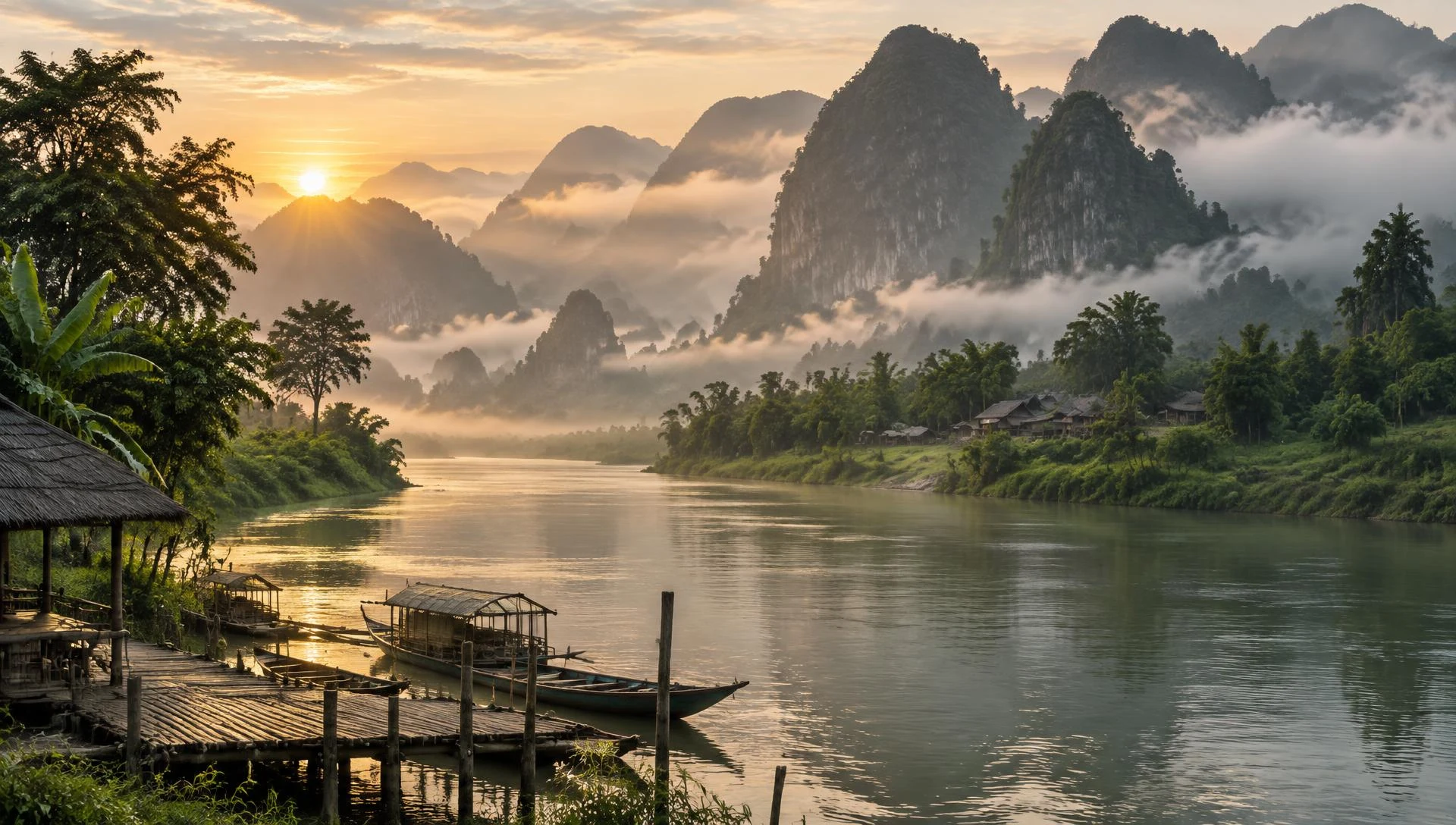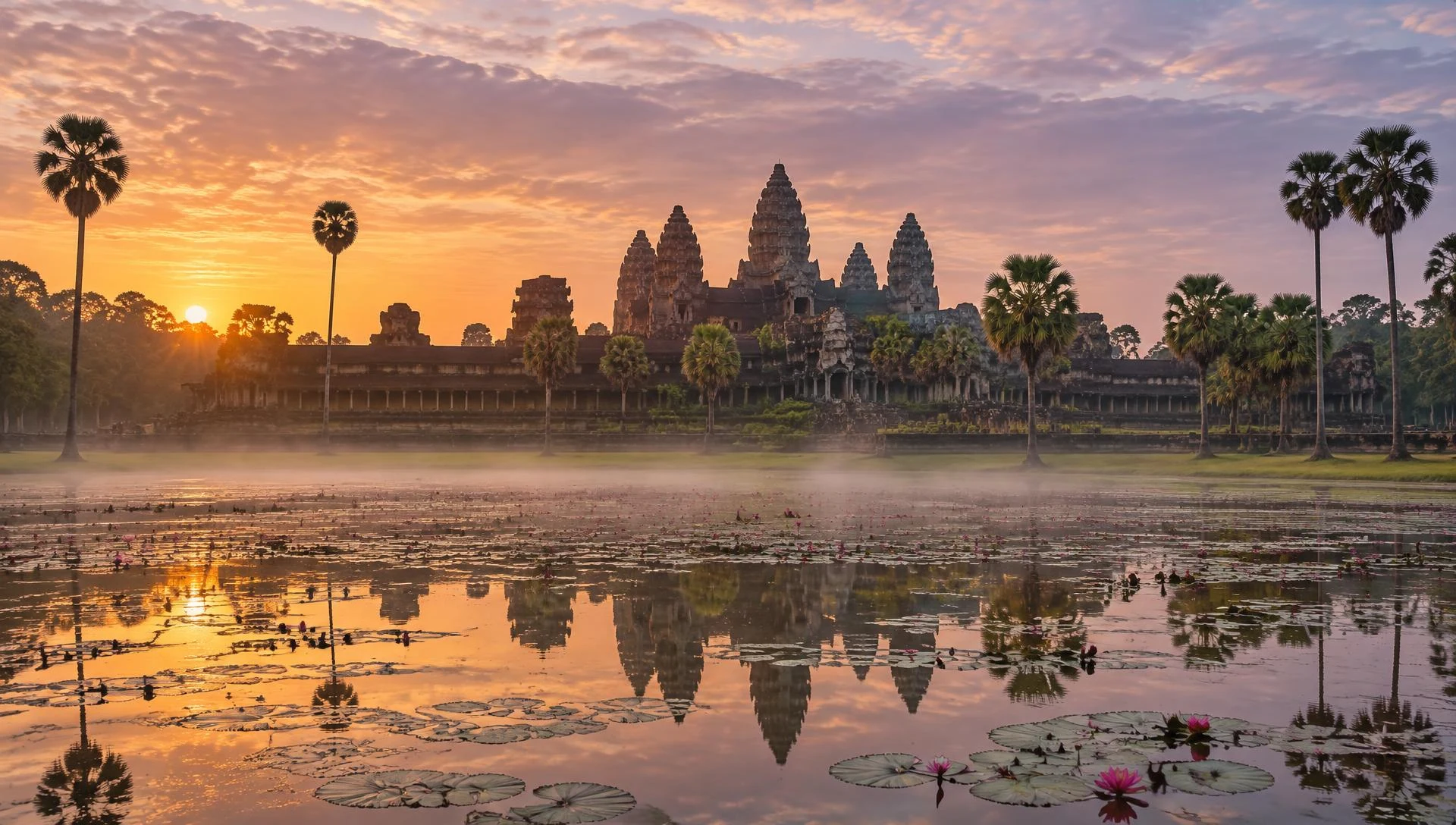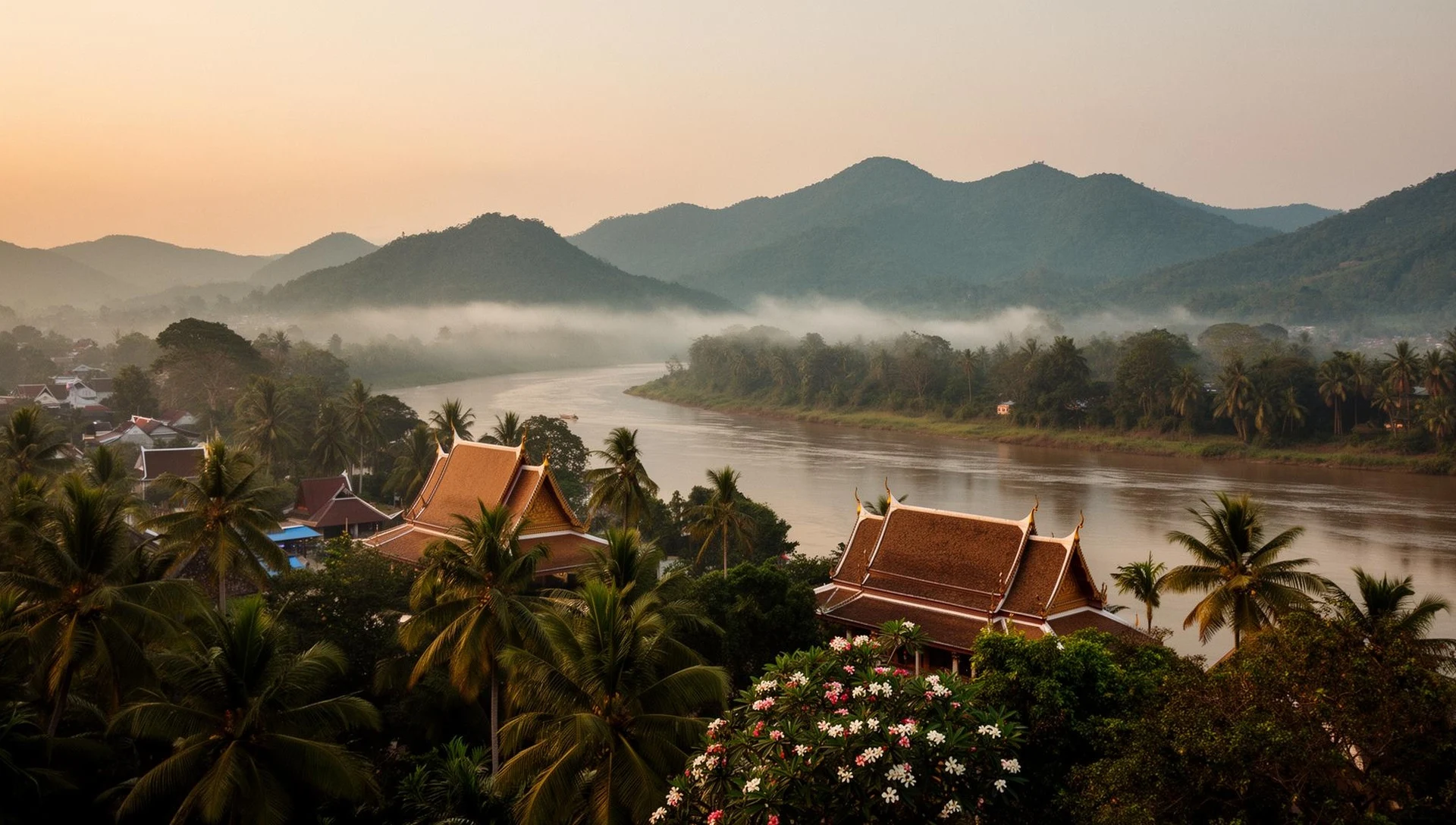
Built on a slender finger of land where the clear waters of the Nam Khan empty into the tawny sweep of the Mekong, Luang Prabang moves to a clock set centuries before the motorcar.
To understand the pull of Laos—a landlocked nation of forested ridges and river valleys tucked between Thailand, Vietnam, Cambodia, China, and Myanmar—begin in its old royal capital at dusk. As the sun drops behind the western hills of Chomphet, the daytime heat lifts off the peninsula. Wooden shutters open along French-Indochinese shophouses, mulberry-paper lanterns glow warm amber beneath dark timber eaves, and the Novice monks of thirty-three active monasteries gather for evening chanting. While Luang Prabang forms the natural centrepiece for anyone traveling through Southeast Asia slowly by river and rail, the town asks you to stop moving altogether for at least four days.
Arrive between November and February, when cool mountain air rolls down the Mekong valley at dawn, or during the quiet green rains of June through September, when frangipani and bougainvillea spill over whitewashed temple walls onto damp brick lanes.
Where two rivers frame a sacred peninsula
Geography protects Luang Prabang’s scale. Because the historical quarter sits on a narrow river peninsula barely a kilometre long and three hundred metres wide, heavy traffic has never found a foothold here. You can walk from the misty banks of the Mekong on the north shore to the bamboo bridges spanning the Nam Khan on the south shore in five quiet minutes.
For centuries this peninsula was the seat of the Kingdom of Lan Xang—the ‘Land of a Million Elephants’—founded in the fourteenth century. When UNESCO designated the town a World Heritage site in 1995, strict conservation rules preserved not just the gilded Buddhist wats, but also the early twentieth-century brick villas with their slatted timber verandas, clay roof tiles, and shaded courtyards filled with lotus jars.
Dawn bells and the quiet etiquette of Tak Bat
Long before sunrise, at four-thirty in the morning, the deep resonance of monastery drums echoes across the dark valley. By five-thirty, as the sky pales to indigo, lines of barefoot monks and novices emerge in silence from their temple gates wearing saffron robes, carrying lidded alms bowls slung over one shoulder.
This daily procession, known as Tak Bat, has taken place unbroken for generations as town residents kneel on woven reed mats along the pavement to place small handfuls of warm sticky rice into each bowl. While the main stretch of Sakkaline Road can draw unhurried onlookers, the most respectful way to witness the ritual is along the quiet back lanes near Wat Sop Sickharam or across the Nam Khan river, standing silently across the street with shoulders and knees covered and cameras lowered.

Wat Xieng Thong and the lanes of the old quarter
At the far tip of the peninsula, where the two rivers meet beneath giant flame trees, stands Wat Xieng Thong. Built in 1560 by King Setthathirath, it remains the finest surviving expression of classic Luang Prabang architecture: its multi-tiered roof sweeps so low toward the earth that it seems to shelter the courtyard like the wings of a bird. Walk through the grounds at seven in the morning, when angled sunlight catches the gold-stencilled teak doors and the famous Tree of Life mosaic set into the rear crimson wall in coloured glass.
Spend the rest of the morning wandering without a map. Pause at the former Royal Palace—modest, airy, and shaded by royal palms—before visiting the Traditional Arts and Ethnology Centre to understand the textile and basketry traditions of northern Laos’s Hmong, Khmu, Tai Dam, and Akha hill communities. Further down the peninsula, studio weavers at Ock Pop Tok work on wooden floor looms beside the Mekong, spinning wild eri silk dyed with indigo, jackfruit wood, and lac.
“In Luang Prabang, the day is measured not by appointments, but by the morning drum, the midday shade, and the hour when the river turns the colour of tea.”
Field ledger: Five slow experiences in and around Luang Prabang
Use this local ledger to structure four or five days across the peninsula, the opposite bank of the Mekong, and the surrounding karst valleys:
| Experience & Setting | Key Places | Optimal Timing | How to Arrive | Defining Character |
|---|---|---|---|---|
| I. The Peninsula Sanctuary | Wat Xieng Thong, Wat Mai, Royal Palace & Nam Khan Lanes | 6:30 AM – 10:30 AM | On foot or vintage bicycle | Sweeping sixteenth-century Lan Xang roofs, glass mosaics & quiet monastery gardens |
| II. The Chomphet Ridge Walk | Wat Long Khoun, Wat Chomphet & Ban Chan Pottery Village | 8:00 AM – 12:30 PM | 5-minute public wooden ferry across the Mekong | Car-free rural paths, cave shrines & panoramic views back across the river to town |
| III. The Turquoise Cascades | Kuang Si Falls Upper Spring Trail & Buffalo Dairy | 7:30 AM – 11:30 AM | Morning Mekong boat + short valley drive | Three-tiered milky-turquoise travertine pools beneath ancient rainforest canopy |
| IV. Living Textile & Craft | Ock Pop Tok Mekong Garden, TAEC Museum & Ban Xang Khong | 2:00 PM – 5:30 PM | Bicycle or tuk-tuk along river road | Natural vegetal silk dyeing, handloom weaving & mulberry saa paper making |
| V. The Nam Ou Karst Valley | Nong Khiaw Limestone Cliffs & Muang Ngoi Neua Village | 2 – 3 night northern extension | Overland valley road + wooden longtail boat | Towering vertical karst peaks, mist-wrapped river bends & quiet hill trails |

Across the Mekong to Chomphet and the pools of Kuang Si
Whenever the peninsula feels even slightly busy, walk down the stone steps behind the old Royal Palace and board the wooden cross-river ferry to Chomphet. Five minutes on the water carries you into another century. On the opposite bank, dirt footpaths wind through banana groves and teak forest past Wat Long Khoun—where Laotian kings once retreated for three days of spiritual purification prior to coronation—and climb hundred-and-twenty stone steps to Wat Chomphet for a quiet view across the Mekong to Mount Phousi.
On your third morning, leave town at seven for Kuang Si Falls, thirty kilometres south. Rather than stopping immediately at the lower pools, follow the forest path to the top of the main sixty-metre cascade where clear calcareous spring water emerges from limestone hills. Walking back down through the shade, you reach the tiered turquoise pools while the water is still completely undisturbed.
North along the Nam Ou: Nong Khiaw, seasons, and arrival notes
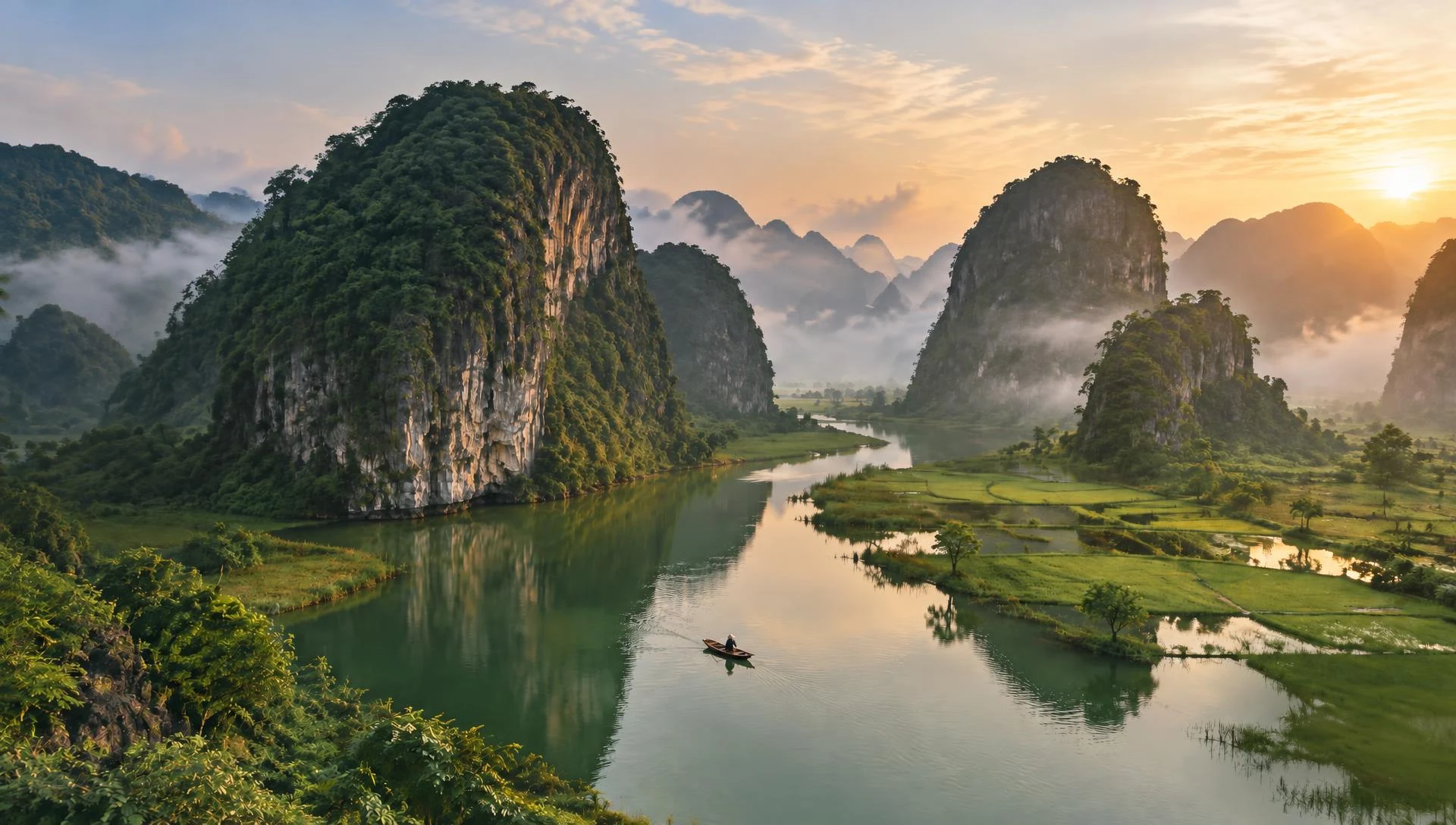
If your schedule allows three extra nights in Laos, follow the Nam Ou River north into the limestone highlands of Nong Khiaw. Where the bridge crosses the river between vertical karst cliffs, mornings begin under a thick blanket of white valley cloud that burns off by nine to reveal emerald peaks. A one-hour longtail boat ride further upstream brings you to Muang Ngoi Neua, a tranquil riverside village of wooden stilt houses and papaya gardens where the afternoon entertainment is watching fishermen cast nets in the shallows.
Back in Luang Prabang on your final evening, find a table along the bank of the Mekong as dusk settles. Order riverweed crisps dusted with sesame (kaipen), smoky eggplant dip (jeow mak keua), and river fish steamed in banana leaves with dill and lemongrass (mok pa). Long after the night market folds its indigo textiles and the last lanterns dim, the sound of the two rivers moving north into the dark stays with you.
Practical Notes
Questions travellers often ask
Where is Luang Prabang located in Laos and how do you get there?
Luang Prabang is located in mountainous northern Laos, roughly 300 kilometres north of the capital Vientiane, set on a narrow peninsula where the Nam Khan River joins the Mekong River. Travellers can reach the town by a two-day slow boat down the upper Mekong from the Thai border at Huay Xai, by direct flight from Bangkok, Hanoi, Siem Reap, or Singapore, or in two hours from Vientiane aboard the Laos–China railway.
When is the best time of year to visit Luang Prabang and northern Laos?
The cool, dry season from November through February is the finest window to visit Luang Prabang and northern Laos. Morning mist lingers over the rivers with crisp temperatures between 15°C and 18°C, warming to sunlit 26°C to 28°C afternoons. Avoid late February through mid-April when regional agricultural burning can create hazy skies in the mountain valleys, or visit during the lush green monsoon from May to October when waterfalls run full.
How can travellers observe the morning alms ritual (Tak Bat) respectfully?
Tak Bat is a living Buddhist meditation rather than a public performance. Unless you have a meaningful personal connection to Buddhist practice, observe quietly from the opposite side of the street rather than stepping into the alms line. Dress modestly with shoulders and knees covered, remain below the eye level of the monks, silence your phone, never use flash photography, and keep several metres of respectful distance.
How many days should you spend in Luang Prabang?
Four to five nights is the ideal stay in Luang Prabang. That pacing leaves two unhurried days for walking and cycling the UNESCO peninsula—visiting Wat Xieng Thong, the Traditional Arts and Ethnology Centre, and riverside verandas—plus separate morning excursions to the Chomphet temple ridge across the Mekong and the turquoise travertine cascades of Kuang Si Falls.
How do you visit Kuang Si Falls without the midday crowds?
Depart Luang Prabang by private car or boat at 7:00 AM so you arrive at Kuang Si Falls right as the forest gate opens at 8:00 AM, two hours before shared minivans arrive. Walk past the main three-tiered waterfall up the shaded forest steps to the natural spring source at the top, then follow the quiet jungle footpath back down to swim in the lower turquoise mineral pools in complete stillness.
What is the best mountain extension from Luang Prabang?
Travel three hours north by road (or a short rail hop to Muang Xai followed by a valley drive) to the riverside town of Nong Khiaw on the Nam Ou River. Framed by sheer vertical limestone cliffs, Nong Khiaw serves as the gateway for a one-hour wooden boat ride upriver to the tranquil village of Muang Ngoi Neua, where forest footpaths lead to weaving hamlets and karst viewpoints.
Share this story