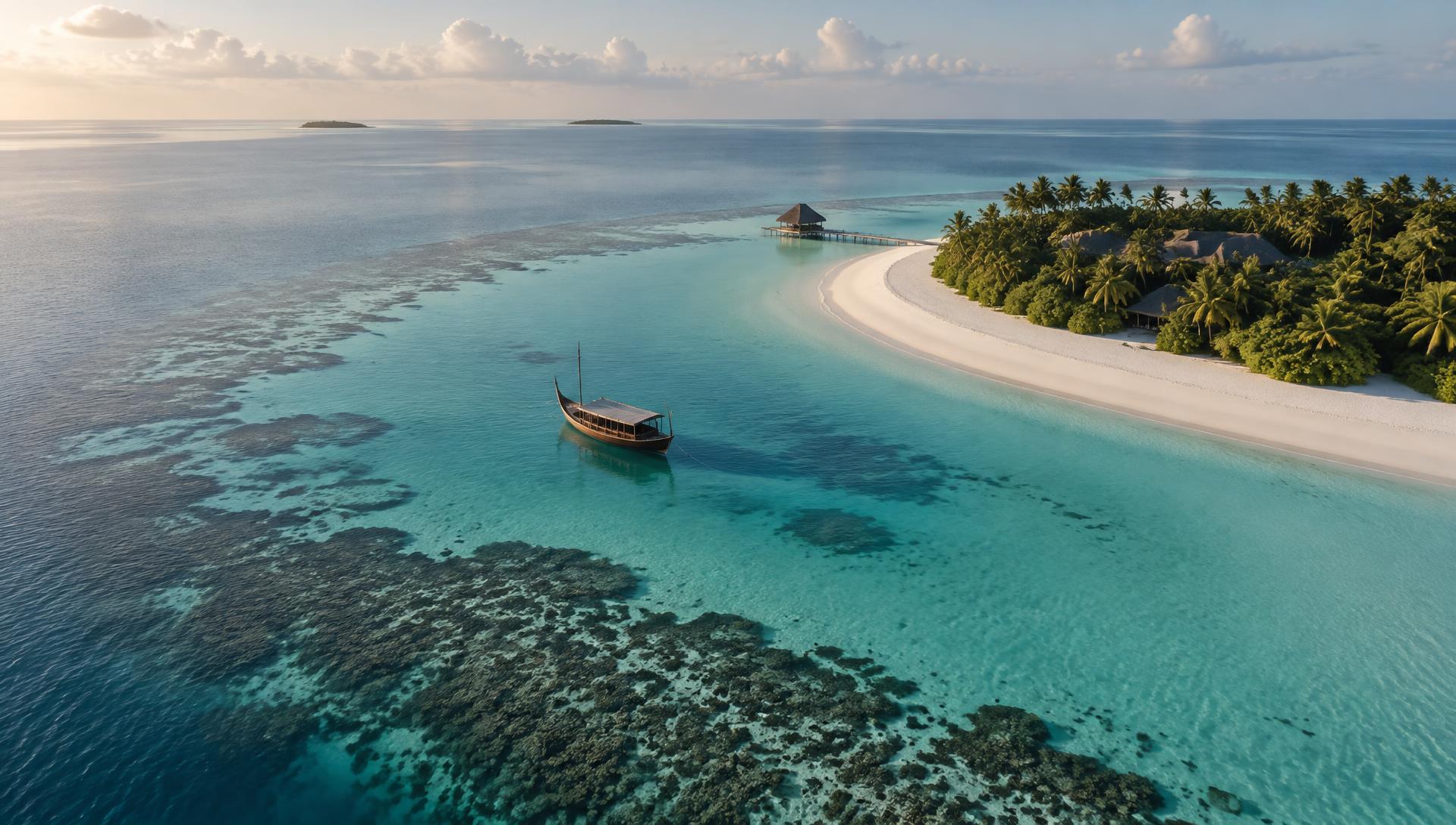
Scattered across eight hundred kilometres of the equatorial Indian Ocean, the twenty-six natural atolls of the Maldives have no hills to catch the clouds—only ring reefs, shifting currents, and two ancient winds.
For travellers researching the best time to visit a Maldives island, the calendar separates into two distinct oceanic moods. From December through April, the northeast dry monsoon—known locally as Iruvai—brings clear skies, gentle breezes, and crystalline lagoon visibility across the archipelago, with daytime air temperatures hovering around 30°C and sea temperatures holding steady at a warm 28°C. From May through November, the southwest monsoon—Hulhangu—sweeps in from the open Indian Ocean, trading glass-still mornings for dramatic cloudscapes, warmer trade winds, lower island occupancy, and the richest marine plankton blooms of the year.
Choosing when to go is therefore a decision between two kinds of luxury: the effortless, postcard stillness of the winter dry months, or the wilder biological theatre of mid-year, when manta rays and whale sharks gather in numbers seen almost nowhere else on earth.
Two monsoons across an equatorial archipelago
Because the highest point on most Maldivian islands is barely two metres above the tide line, weather here behaves differently than on mountainous tropical islands like Bali or Sri Lanka. There is no high terrain to hold grey skies in place. Even outside the peak dry months, a squall that darkens the western horizon at three in the afternoon often passes within forty minutes, leaving the coral sand cool underfoot and the lagoon glowing rose-gold by sunset.
For centuries, Maldivian sailors navigated by the Nakaiy—an indigenous calendar of twenty-seven roughly two-week weather periods nested inside the two main monsoons. Understanding that subtle progression helps modern travellers time everything from channel dives to sandbank crossings.
December to April: The calm skies of the Iruvai season
By mid-December, the northeast wind settles in and humidity drops noticeably. Between January and March—widely considered the best time of year to visit the Maldives for pure coastal serenity—the ocean surface inside the atoll lagoons flattens into a sheet of translucent glass. Seaplane flights out of Malé enjoy crisp aerial visibility over the ring reefs, and evenings are dry enough for barefoot dining on open sandbanks.
During these months, ocean currents flow predominantly from east to west through the atoll channels. Along the eastern outer reefs, clean oceanic water pushes against the coral walls, pushing underwater visibility past thirty metres for divers exploring overhangs of soft coral, eagle rays, and reef sharks.

Why April and late November reward unhurried travellers
If your dates are flexible, late November and the whole of April offer a quiet sweet spot. In April, the wind drops almost completely as the monsoons prepare to turn, leaving the water mirror-still and remarkably warm for long twilight snorkels along the house reef, while island villas are far quieter than in February.
“On an outer atoll, you stop measuring the day by hours and begin measuring it by the turn of the tide across the reef flat.”
May to November: The marine life and quiet of Hulhangu
When the southwest Hulhangu monsoon arrives in May, the ocean breathes more deeply. While you should expect higher humidity, breezier afternoons, and passing tropical showers between May and October, this season unlocks the archipelago’s greatest ecological spectacle.
From June through October, currents concentrate microscopic plankton inside the funnel-shaped reef of Hanifaru Bay in Baa Atoll, a UNESCO Biosphere Reserve. Slipping into the water with a snorkel around the full or new moon, you can watch fifty to a hundred reef manta rays barrel-rolling in slow, choreographed loops just metres below the surface. Meanwhile, surfing swells wrap cleanly around the outer reefs of North Malé, Thaa, and Laamu atolls.
Maldives month-by-month weather and reef almanac
Use this seasonal ledger to match your preferred island experience with the shifting currents and skies across the atolls:
| Months | Monsoon Phase | Air / Sea Temp | Lagoon & Visibility | Best For |
|---|---|---|---|---|
| January – March | Peak Dry Season (Iruvai) | 30°C / 28°C | Glass-calm seas; 30m+ eastern reef visibility; lowest rainfall | First-time island stays, channel diving, sandbank dinners, pairing with Sri Lanka |
| April | Late Dry Transition | 31°C / 29°C | Mirror-still lagoons; warm, windless days | House-reef snorkelling, photography, shoulder-season quiet |
| May – July | Early Southwest (Hulhangu) | 30°C / 28°C | Breezy with passing squalls; rising plankton levels; clean surf swells | Early manta sightings in Baa Atoll, outer-reef surfing, tranquil villa stays |
| August – October | Peak Marine Season (Hulhangu) | 29°C / 28°C | Moderate visibility (15–20m) rich in nutrients; warm tropical winds | Peak Hanifaru Bay manta ray & whale shark gatherings; long-stay rates |
| November – December | Autumn Transition to Dry | 29°C / 28°C | Clearing skies and calming seas by mid-December | Early winter sun, South Ari whale sharks, pre-holiday serenity |

Choosing between northern, central, and southern atolls
Geography matters as much as the calendar. The central atolls—North and South Malé, Ari, and Felidhoo—are reachable by speedboat or a short twenty-minute seaplane hop, making them effortless for shorter stays of four or five nights. Further north, Baa, Raa, and Noonu atolls offer wide, lagoon-ringed islands with lush interior banyan forests and world-class biosphere reefs.
In the deep south, across Laamu, Gaafu Alifu, and Addu near the equator, fewer islands have been developed. Because these southern reefs sit below the main monsoon belt, they often enjoy brighter skies during June, July, and August, alongside pristine hard-coral gardens rarely visited by day boats.
The rhythm of an outer-island day
To experience the Maldives beyond the cliché of a sun lounger, tune your days to the reef edge. Swim the drop-off at six-thirty in the morning, when nocturnal jacks and hawksbill turtles patrol the coral wall in slanted silver light. Spend the warm midday hours in the shade of sea-almond trees or sailing a traditional dhoni across the lagoon to an uninhabited sand spit, and return to the jetty at dusk as blacktip reef sharks trace the shallows beneath the first stars.
Practical Notes
Questions travellers often ask
When is the best time to visit the Maldives for dry, sunny weather?
The best time to visit a Maldives island for uninterrupted sunshine, low humidity, and glass-calm turquoise lagoons is during the northeast dry monsoon (Iruvai) from December through April. Between January and March, rainfall is minimal, daily temperatures average 29°C to 31°C, and underwater visibility along the eastern atoll channels frequently exceeds 30 metres.
What is the best month to visit the Maldives for value and good weather?
November and April serve as the two finest shoulder months in the Maldives. Both sit on the edge of the dry season—offering eight to nine hours of daily sunshine, warm 28°C sea temperatures, and calm boat transfers—while island resort rates and seaplane availability are noticeably more relaxed than during the peak Christmas to February window.
When is the best time to go to the Maldives for manta rays and whale sharks?
For huge aggregations of reef manta rays and whale sharks in Baa Atoll's UNESCO-protected Hanifaru Bay, the best time to go to the Maldives is between June and October during the southwest monsoon (Hulhangu). Plankton-rich currents funnel into the bay on lunar tides, drawing upwards of a hundred feeding mantas at once, while South Ari Atoll offers year-round whale shark encounters.
Does it rain all day during the Maldives wet season from May to October?
Rarely. Even during the southwest monsoon between May and October, rain across the atolls typically arrives as dramatic, passing tropical squalls in the late afternoon or overnight, followed by bright skies and warm winds. Because the islands have no mountains to trap clouds, storms move quickly across the open horizon.
Do the southern atolls have different weather from Malé and the northern atolls?
Yes. Because the Maldivian chain stretches more than 800 kilometres north to south across the equator, the far southern atolls—such as Laamu, Gaafu Alifu, and Addu—experience a more equatorial microclimate with gentler monsoon transitions and lighter winds during the mid-year months compared to the northern atolls.
Can you pair a Maldives island stay with Sri Lanka in a single itinerary?
Yes. Malé lies just a 90-minute direct flight southwest of Colombo, and the dry season from December to April aligns across both the Maldives atolls and Sri Lanka's southern coast and hill country—making a ten-day overland route through Sri Lanka followed by four quiet nights on a Maldivian reef one of Asia's classic pairings.
Share this story